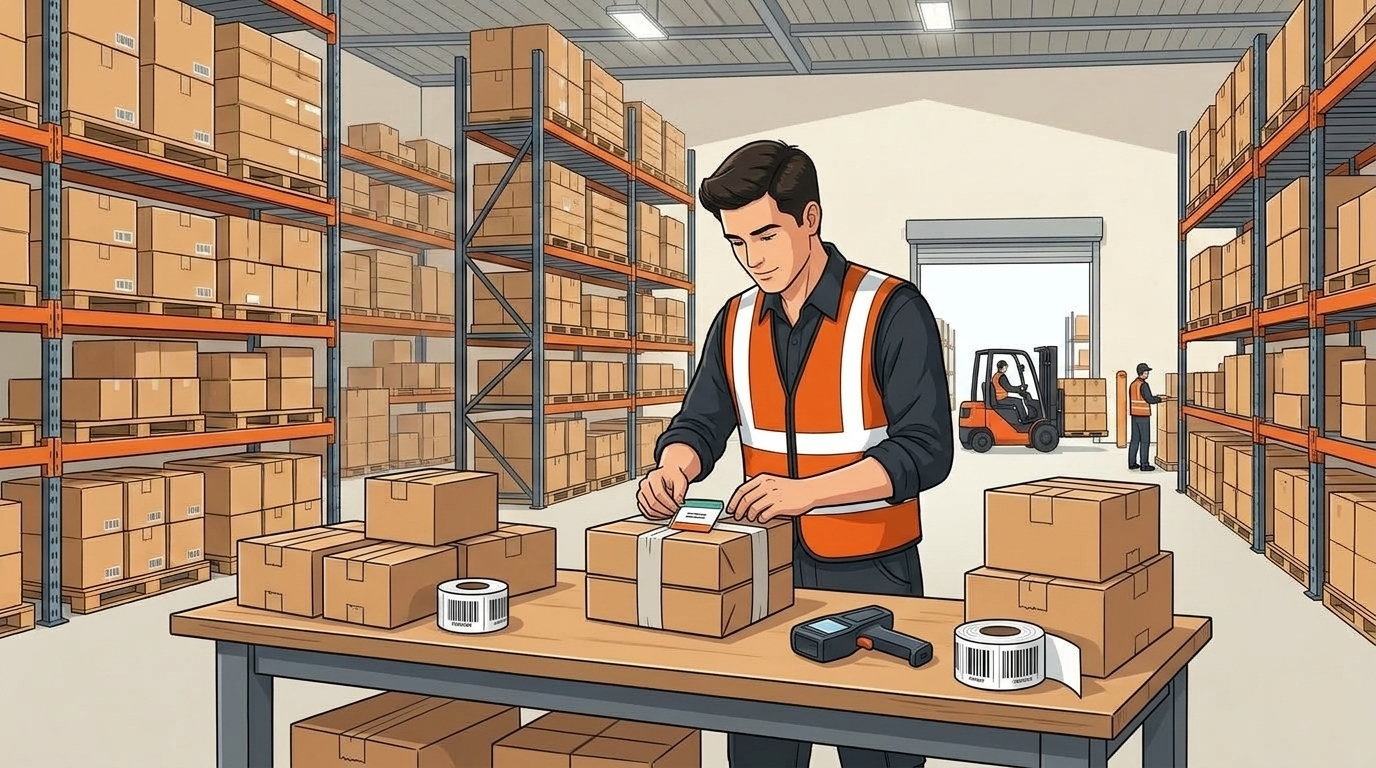



Most liquidation auction businesses are not limited by demand. There are always bidders. They are limited by how many pallets they can turn into listed lots in a week, and that ceiling is set by the workflow on the warehouse floor.
This is the full sequence, stage by stage, with the failure mode that shows up at each one.
1. Buy against a manifest you have actually read
The workflow starts before the truck does. Price off cost percentage and landed cost per unit rather than gross retail value, discount hard for untested and for missing condition data, and check the structural red flags in the file.
Where it breaks: buying off the extended retail total because it is the biggest number on the page.
2. Book the dock
Inbound arrivals need slots the same way outbound pickups do. Three trucks at one door on a Tuesday morning means the third one sits, and a driver waiting is a cost somebody is paying.
Where it breaks: arrivals arranged by text message, with nobody in the building knowing what is landing today.
3. Receive and reconcile
Unload, count, and check what came off against what was claimed. This is the single highest-value ten minutes in the entire process, because it is the only moment when a shortfall is still arguable with the seller.
Import the manifest before the truck is unloaded so every claimed line exists as an expected unit. Then scan units in against it. Three things become visible: lines claimed but never scanned, units with no matching line, and units whose real condition is worse than the manifest said.
Where it breaks: receiving fast without receiving accurately. Storage time is pure cost, so the pressure to just get it off the truck is real, and it is why most shortfalls are discovered a month later, when nothing can be done.
4. Triage before you touch
Not every pallet deserves the same treatment. Some loads should be broken to the unit and sold individually. Some should go out as pallet lots exactly as they arrived. Some should go to a bin store or straight to wholesale.
Every additional touch costs money. On low-value goods, individual processing can cost more than the units will ever recover. Triage is the decision about how much labour a pallet is worth, and it should happen before the labour is spent, not after.
Where it breaks: processing everything the same way, then discovering that a category of goods costs more to list than it sells for.
5. Grade it once, at the label
Condition is the field that drives price, and it is the field most likely to be inconsistent. Two staff on two shifts will not agree on what “open box” means unless you tell them.
Grade against a fixed list rather than free text. Set the grade at the same moment the label is printed, so grading is one action inside an existing step rather than a separate pass. Make the field required so nothing reaches the rack ungraded.
Where it breaks: grades drifting across staff and locations, producing data that cannot support pricing. By lot eight hundred, the grades no longer mean what they meant at lot one.
6. Tag and bin
Every unit gets a code and a location. Bin-level placement is what makes a broken-down pallet findable again. A unit assigned to a warehouse rather than a bin is a unit somebody will spend twenty minutes looking for on pickup day.
Camera-based scanning matters here for a practical reason: it removes the hardware purchase that otherwise gates the whole workflow. Any phone works, so a seasonal hire can be productive on their first shift.
Where it breaks: units in the building with no location assigned. Watch that count, and watch how long they have been sitting like that.
7. Photograph and describe
The cataloging bottleneck is the most documented pain point in this industry, and the numbers behind it are ugly. Industry sources put manual cataloging somewhere between four and nineteen minutes a lot depending on complexity, which across a two-thousand-lot sale becomes a labour cost you can measure in thousands of dollars.
That is the stage where auction dates start slipping. Catalog production begins dictating the schedule instead of supporting it.
Photograph once, well, and generate the description from the photos rather than typing it. Whatever the description takes, multiply it by your annual lot count before deciding it is fine.
Where it breaks: description quality drifting as the day wears on, and sale dates set by how fast the catalogers can go.
8. Build the lots
Lotting strategy is profit strategy. High-value units go out individually. Filler goes out bundled. Bulk goes out as pallet lots. The decision is a function of unit value against the labour cost of listing it separately.
Whatever you decide, the lot should assemble from inventory that already has titles, photos, and grades attached. Retyping any of that is pure waste, and it is where transcription errors enter the listing.
Where it breaks: lot numbering chaos from late inserts and splits, and units accidentally committed to two lots.
9. Publish to your channel
You do not need to move your auction off the platform your bidders already use. What you need is for the finished lot to arrive there without a human re-keying it, and for the resulting invoice to come back automatically.
Where it breaks: staff moving information between systems that were never designed to talk, which produces duplicate entry, delayed launches, and invoice corrections.
10. Invoice, pack, and stage
The auction closes and the hard part starts. Track payment, packing, and pickup as three separate statuses, because an invoice can easily be paid and unpacked, or packed and unpaid.
Pack against a scan of the unit and the bin, so what leaves matches what was sold. Flag exceptions explicitly rather than letting a job silently go out short.
Where it breaks: the week after closing feeling worse than the auction itself.
11. Release with proof
Let buyers book their own pickup window, with a cap on how many can take the same slot. Scan the invoice at the counter to pull up the lots and their locations. Capture a signature, an ID, or a PIN before anything leaves.
Publish your terms and enforce them: a late fee, a daily storage charge, and a date at which unclaimed lots are forfeited and relisted. Non-paying bidders and no-shows are a permanent feature of this business, and the only defence is a written policy applied consistently.
Where it breaks: phone tag to arrange collections, queues in the yard, and lots nobody can find while a buyer waits.
12. Close the loop
Read recovery back to the pallet and the supplier. Which loads returned what, how long they took, and how much never sold at all. That is the number that decides whether you bid on that supplier’s next truck.
Where it breaks: never doing it, and buying the second bad load from the same seller.
The thread running through all of it
Every failure above is a version of the same problem: information getting recreated instead of carried forward. The manifest lives in a spreadsheet, the condition lives in somebody’s head, the location lives on a sticky note, the listing gets typed fresh, and the recovery number is assembled by hand at month end if anyone gets to it.
One record per unit, from the manifest line to the buyer’s signature, is what removes the re-keying, and removing the re-keying is what raises the ceiling on how many pallets a week you can actually move.
Explore the workflow stage by stage: receive and grade, tag and store, list and sell, and pickup and delivery.
Asked questions
Frequently asked questions
Key operational insights regarding this topic.
Top-performing operators turn inbound pallets into cataloged auction lots within 48 to 72 hours of dock arrival to maintain warehouse velocity and minimize holding costs.
Testing and grading customer returns. Without a clear grading protocol, items pile up in staging areas and delay lot creation.
Pre-slot pickup appointments in 15-minute windows and stage won lots near customer-facing bays prior to buyer arrival.