


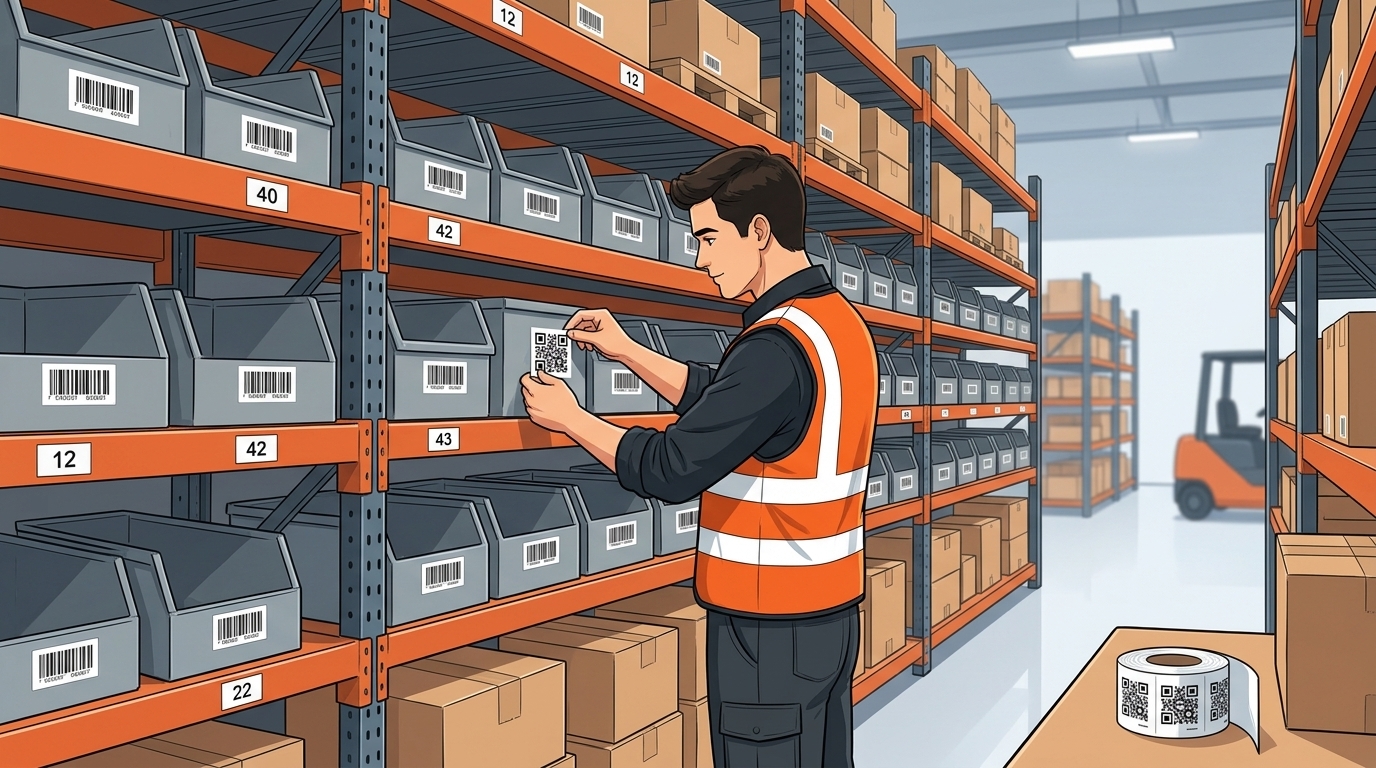
In a traditional fulfillment warehouse, items have fixed shelf homes: SKU 1234 always sits on Rack 04, Shelf 2. But liquidation auction warehouses do not work that way. Every truckload brings hundreds of unique, unrepeatable items and one-of-a-kind lots that will be in the building for exactly ten days before departing with a winning bidder.
If you rely on staff memory or handwritten sticky notes to remember where lot #452 was placed, your warehouse will inevitably experience lost merchandise, delayed buyer loadouts, and costly customer refunds.
Here is the blueprint for creating a scalable, mistake-proof bin location system tailored specifically for fast-turn liquidation inventory.
1. Hierarchical Alphanumeric Naming Syntax
Your bin labeling scheme must be instantly intuitive to new temporary warehouse staff while remaining strictly unique across your entire facility footprint.
Use a 4-part hierarchical address:
[ A03 ]  -  [ 12 ]  -  [ C ]  -  [ 04 ]
Aisle Bay Shelf Position- Aisle (A01 - A20): Clearly marked with hanging overhead signs visible from both ends of the row.
- Bay (01 - 30): The physical upright rack section, numbered sequentially away from the main dock doors.
- Shelf Level (A - E): Vertical tiers, where A is ground level, B is waist level, and D/E represent higher top-rack pallet positions.
- Position (01 - 10): Specific tote, box, or pallet positions along that crossbeam.
Every single location—from a small plastic parts bin up to a 48x40-inch pallet slot—gets a durable laminated vinyl label containing both bold text and a scannable 2D QR code.
2. Velocity-Based Slotting Architecture
In an auction business, picking velocity peaks during tight 48-hour post-auction pickup windows. Do not store small, popular electronics in remote top racks that require a forklift to retrieve while twenty buyers are queuing in the lobby.
Designate three distinct operational storage zones:
- Active Staging Floor (Zone A): Low-profile ground shelving and floor lanes directly adjacent to the customer collection bays. Lots closing in the current week’s auction are transferred here 24 hours before closing.
- Standard Auction Racking (Zone B): High-density shelving for lots cataloged for future events running in 1 to 3 weeks.
- Bulk Skid Reserves (Zone C): Top racking and remote deep-storage lanes for untouched wholesale skids awaiting triage.
3. Mandatory Mobile QR Scan-to-Move
The secret to 99.9% inventory accuracy in an auction warehouse is non-negotiable software enforcement: no physical object moves without a digital scan.
- Putaway: The cataloger finishes building Lot 340. They scan the Lot QR tag, then scan the target bin QR code (
A04-08-B2). The system instantly binds the lot to that physical coordinate. - Relocation: If a picker moves a pallet to clear space, they scan the pallet and scan the new slot. The software updates immediately.
- Pick and Verify: When picking customer invoices on collection day, the mobile terminal prompts the picker with the shortest sequential route and refuses to close the invoice until the correct bin and lot labels are verified.
Asked questions
Frequently asked questions
Key operational insights regarding this topic.
Standard 2D QR codes or Data Matrix symbologies are superior to 1D barcodes because they can be scanned from steep angles, greater distances, and when partially scratched or smudged.
Adopt an intuitive 4-tier syntax such as A02-04-B3 (Aisle 02, Bay 04, Shelf Level B, Bin Position 3) with human-readable bold text alongside the 2D code.
Yes. Dynamic chaotic storage works exceptionally well for liquidation auctions as long as every item move is instantly recorded via barcode scan in the warehouse system.